

How Do You Reduce The Size Of A Photo
The principal way to reduce the file size of an image is by increasing the amount of compression. In most prototype editing applications this is done by the selections you make in the "Salve As" or "Export As" dialog box when saving a PNG, JPG, or GIF. The more than compression, the smaller the file will be and the faster it will load on a webpage.
Only offset, y'all'll demand to decide which of the three file formats yous want to employ. If your image is a photograph with lots of colors or an analogy with gradations and you desire to squeeze the file size down, JPEG will probably be your best option. If a like photo needs to have lossless pinch or transparent areas, then a PNG-24 volition exist required. If you take a simple graphic with few colors and solid areas, then your best choice will be a GIF or PNG-8. Nosotros'll have a await at how to become the all-time compression in each of the three file types starting with JPEGs. For information about compressing PNGs or GIFs, delight curl down this page.
Compressing a JPG
Information technology's easiest to compress a JPG (likewise called JPEG) considering there'due south just i thing to consider: quality. When you consign to JPG from an image editing plan, yous'll be prompted to select the quality level you want. You lot might just see a few choices similar: low, medium, loftier, or maximum. You might be given a number range, for example 0 (everyman quality) to 12 (highest quality). Or you lot might be asked to select a percentage from 0% (everyman quality) to 100% (highest quality). Yous should always select the everyman quality that is withal suitable for your purpose.
Ane strategy for selecting the best level is to start with a fairly high quality setting and if it looks OK, endeavour reducing the quality a bit. If the reduced level looks expert enough, then try some other reduction. When you hit a quality level that is unsatisfactory, so back up to the lowest level that was withal good enough for your purposes. Always keep in heed what the purpose of the graphic is. If you are posting a flower photo to a botanical encyclopedia website, you probably want it to be fairly loftier quality so small distinguishing details can be clearly seen. If you are posting a flower photo simply to gloat the arrival of spring, and then a much lower quality would probably be fine. Let's have a slice of a flower photo and export it out at six different quality settings.
100% quality, 103 KB file size
The image below was exported at 100% quality. 1 would rarely ever need this setting.
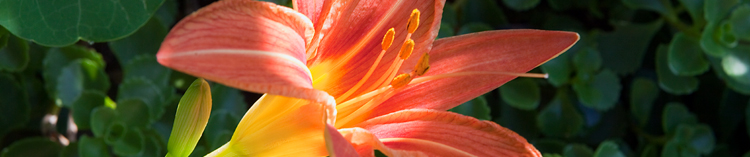
lxxx% quality, 48 KB file size
The 80% setting is most indistinguishable from the 100% setting. But let'southward meet if we can compress it further.
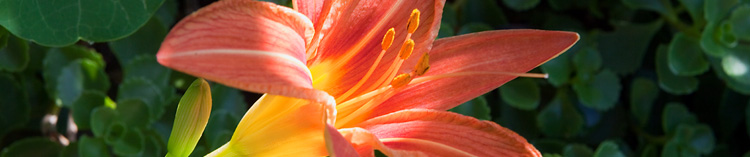
60% quality, 28 KB file size
Even at 60% most people wouldn't notice any difference from the 100% setting and since information technology's a quarter the size, it would load four times as fast.
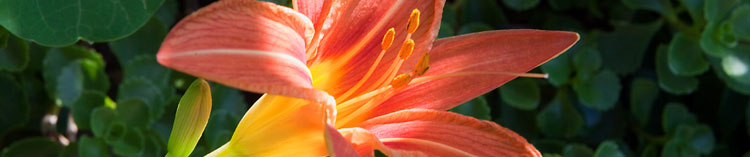
40% quality, 17 KB file size
For many general uses, even this 40% quality image would be acceptable. And five times faster to load than the original.
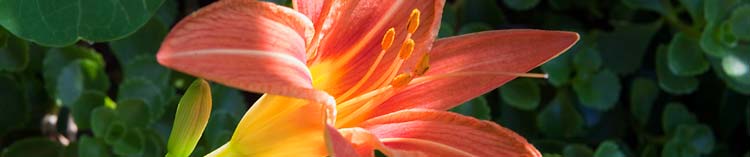
xx% quality, 12 KB file size
Getting ugly here.
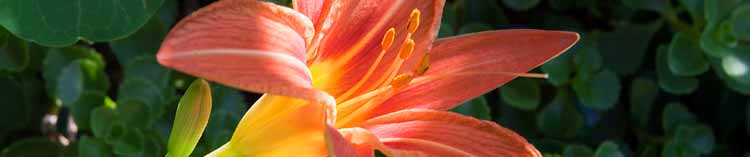
0% quality, 7 KB file size
The blockiness of farthermost JPG compress in very obvious.
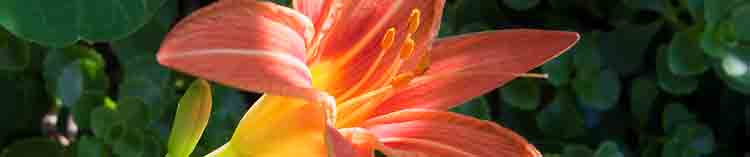
Sample photo from FCIT'due south collection of stock plant photos on the ClipPix ETC website.
Another fashion to salve file size with JPG is to slightly mistiness the image earlier you lot compress it. An epitome with fewer precipitous edges and crisp details will compress much smaller. Perhaps yous intend to apply a photo every bit a background image. That'due south a perfect case for using a blurred photo. Y'all can even mistiness just parts of an epitome and achieve file savings. Below is a photo of a day lily with a busy groundwork. The file size is 77 KB when compressed at 60% quality.
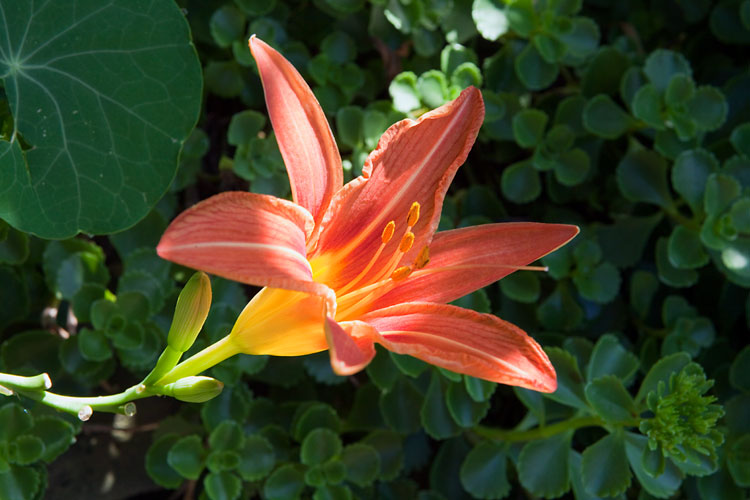
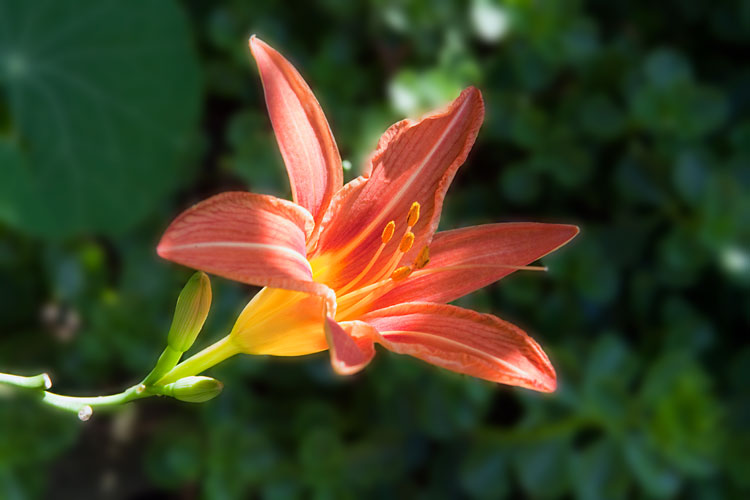
If nosotros take that aforementioned prototype, select the groundwork in an image editing plan like Photoshop, and and so blur the selection, only the background will blur and the flower volition remain precipitous. The photo below was exported to JPG at the aforementioned 60% quality setting as above and is only 54 KB—a savings of about thirty% of the file size so information technology will load much faster. In this instance, we end up with a slightly more artistic photo where the focus remains properly on the flower itself and also achieve significant savings in file size. That'south a win-win.
One final note about JPG. Retrieve that this is a lossy format. Every time y'all salvage a file as a JPG, you lose quality. If yous call up that you lot'll always want to utilise the same photo again, brand sure you relieve your original in a format like TIFF or PSD and then simply export the file to JPG. That gives you both the compressed JPG to use on the Spider web and your original uncompressed file that y'all can utilise once more later. The one thing you definitely don't desire to do is save your only copy of a file as a compressed JPG, reopen it to edit, and save information technology out again as a JPG. That's similar making photocopies of photocopies. Each fourth dimension the quality will get worse. It'due south e'er amend to go back to your original, uncompressed file.
Compressing a GIF
The traditional option of file blazon for graphics consisting of elementary areas and few colors is GIF, although one can now achieve the same results with a PNG-viii (and at a smaller file size).
GIF images are limited to 256 colors, but you can set a lower color depth for substantial savings in file size. For the all-time results endeavour to get at or but under one of the following numbers of colors: 256, 128, 64, 32, 16, 8, 4, or 2. For example, if your image has 33 colors in information technology yous'll exist able to shave off a lot of the file size if you can reduce the palette to 32 colors, simply you won't get the same savings moving from 32 downward to 31 colors.
See "What is bit depth?" for more information and instance images.
When you save (or export) equally a GIF, first select the number of colors you want in your terminal image. Second, if you lot notice "banding" in areas of gradients, the image probably wasn't a expert candidate for GIF in the first place but y'all can make the banding less obvious by selecting a dither design—usually the "improvidence" pattern will work best. Tertiary, if you lot have transparent areas of your epitome, make sure to select "transparent."
There are a few settings you can ignore. Leave "Web snap" gear up to zero. This setting is a left-over from the days when nigh monitors didn't brandish the millions of colors that they practise today. The "Matte" setting used to be very useful for helping alloy the edges of a transparent GIF into the background, only if that's a trouble for a detail image, you should probably switch to PNG anyway.
And, of course, GIF has been the traditional choice for animated images, although PNG is poised to take over that area likewise.

Sample graphic from FCIT's drove of robot illustrations on the TIM website.
Compressing a PNG
We finally go to PNG. It's concluding on the listing not because it'due south the least important, but because information technology incorporates features of both JPG and GIF. Its popularity has been growing steadily and, by some estimates, is at present used on more than websites than either JPG or GIF. Information technology may seem a bit more circuitous at first, but if yous will exist creating web graphics on a regular ground, information technology'southward certainly worth mastering.
First, you'll demand to determine whether to export as PNG-8 or PNG-24. PNG-8 is similar GIF in that it's all-time for graphics with few colors and solid areas like logos. The major deviation between PNG-8 and GIF is that the PNG-8 file will by and large be smaller than a GIF file. PNG-24 is like to JPG in that it's best for continuous-tone images like photographs or other images with more than 256 colors. The major difference betwixt PNG-24 and JPG is that PNG-24 is lossless so the file size volition be somewhat larger than a JPG, just the quality will exist higher.
Exporting equally a PNG-viii. If you export to PNG-viii from a graphics program yous volition see an interface that is very like to GIF. Like a GIF, you'll need to select the number of colors (2, 4, 8, 16, 32, 64, 128, or 256), whether to add together a dither pattern or not, and whether you demand transparency or not. The only significant divergence is that the PNG-8 will exist slightly smaller.
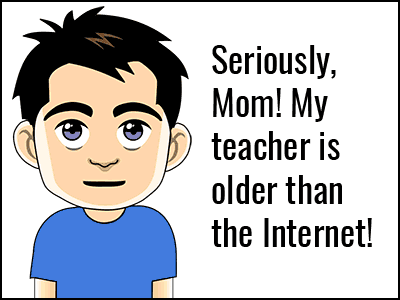
Hither's a drawing exported as a 32-color GIF. The file size is thirteen.6 KB.
Here's the aforementioned cartoon exported every bit a 32-colour PNG with exactly the aforementioned settings as in a higher place. The file size is ten.ii KB. That'south a 25% savings in file size.
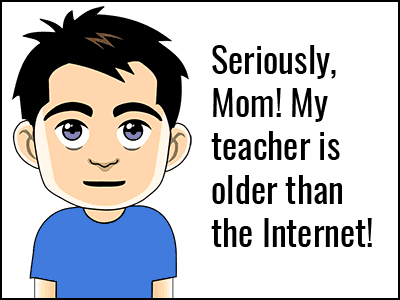
Sample graphic from FCIT's collection of tech cartoons on the TIM website.
Exporting as a PNG-24. Since PNG-24 is a lossless format, you really don't have any options near quality when exporting. Unlike a JPG, no paradigm data is discarded. That too means the file size can exist quite large.
Here's a photo of macaws exported as a PNG-24. Its file size is 400 KB. That's pretty large.
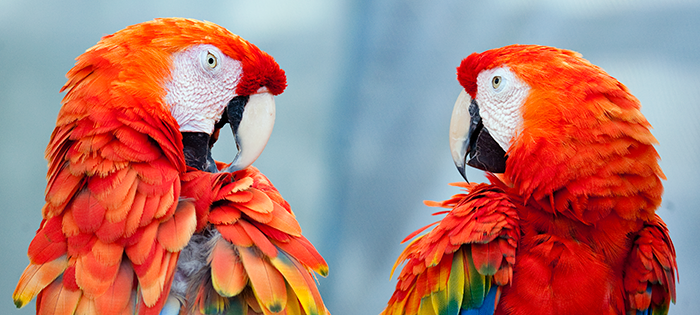
Hither'due south the aforementioned photograph exported as a JPG at the maximum quality (100%) setting. Its file size is 259 KB.
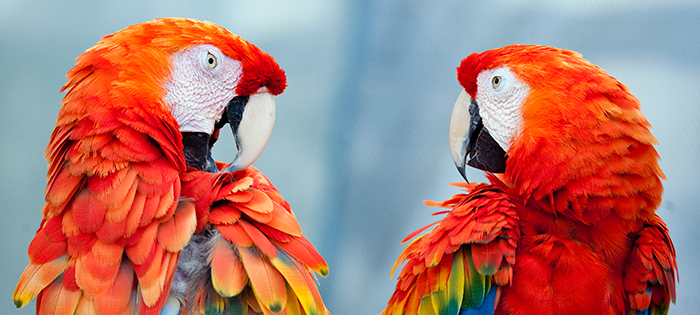
And hither's the same photo exported as a JPG at the high quality (60%) setting. Its file size is only 69 KB.
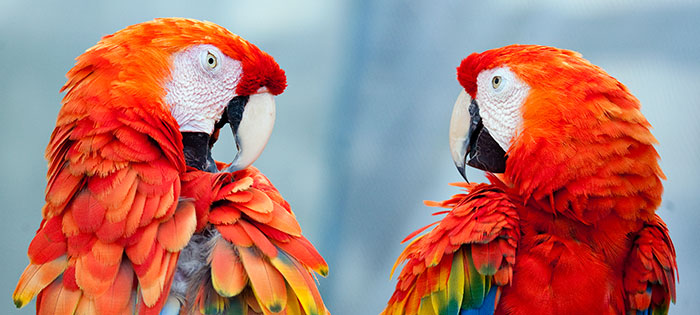
Sample photo from FCIT's collection of stockanimal photos on the ClipPix ETC website.
Wow, if the PNG is 5 or 6 times the file size of a serviceable JPG, why would I always desire to utilise information technology? Well, there could exist multiple reasons for choosing the PNG-24 over a JPG.
1. If you demand transparency in the image, the PNG is necessary because JPGs don't support transparency.
2. If you want a lossless format, you'll need the PNG because even at the maximum setting, a JPG loses information and the paradigm degrades fifty-fifty if information technology is not apparent at first glance.
three. If y'all absolutely need a clear epitome with no JPG compression artifacts, PNG is your choice. A expert instance is a screenshot that includes lots of small type. Past its very nature, a JPG is going to "smudge" the type making information technology slightly harder to read. The PNG will reproduce the type pixel-by-pixel merely as information technology appeared originally on the screen.
Related pages
What is the departure betwixt bitmap and vector images?
What is bit depth?

How Do You Reduce The Size Of A Photo,
Source: https://etc.usf.edu/techease/win/images/how-do-i-reduce-the-file-size-of-an-image/
Posted by: deaninteall.blogspot.com
0 Response to "How Do You Reduce The Size Of A Photo"
Post a Comment